.gif)


We've all been there. You finally found the perfect candidate for your client. The interviews went smoothly, and everyone is excited about moving forward. Then comes the onboarding process, and suddenly everything slows down. Documents get lost in email chains. Forms remain incomplete. Days turn into weeks. Before you know it, that perfect candidate has accepted another offer, and your client's trust starts to waver.
This scenario plays out in staffing agencies every single day. In fact, studies show that 50% of candidates fail to complete their employment forms, and of those who do, only 60% actually show up on day one. That's a staggering loss rate that no agency can afford to ignore. The good news? The right onboarding software for staffing agencies can turn this nightmare into a smooth, efficient process that keeps everyone happy and engaged.
Understanding Onboarding and Why It Matters
Before we dive into solutions, let's talk about what onboarding really means. The onboarding definition goes beyond just filling out paperwork on someone's first day. True employee onboarding is the comprehensive process of integrating new hires into your organization and preparing them to succeed in their roles. It starts the moment a candidate accepts an offer and continues through their first few months on the job.
The onboarding process includes several critical steps. We're talking about collecting necessary documents, completing compliance forms like I-9 verification, setting up payroll and benefits, providing access to company resources, introducing company culture and policies, and ensuring the new hire understands their role and responsibilities. When done right, this process creates confident, engaged employees who are ready to hit the ground running.
For staffing agencies, the onboarding meaning takes on even more significance. You're not just onboarding someone into your agency. You're preparing them to work with your clients, often in fast-paced environments where delays simply aren't acceptable. Every hour of delay costs your agency credibility and money.

The Unique Challenges Staffing Agencies Face
Staffing agencies operate in a completely different world than traditional corporate HR departments. While corporate HR manages a straightforward relationship between company and employee, we juggle three relationships simultaneously. We need to satisfy our candidate's experience, meet our client's specific requirements, and maintain our own compliance standards. Each party has different needs, timelines, and expectations.
This complexity multiplies as your agency grows. One client might require HIPAA compliance for healthcare workers. Another needs specific safety certifications for construction placements. A third demands security clearances for government contracts. Traditional onboarding software simply can't handle this variety because it treats every placement the same way.
Then there's the volume challenge. The average staffing agency processes over 200 placements monthly. That's roughly ten new hires every single working day. Each one requires documents, verifications, and client-specific requirements. Without proper employee onboarding software, your team drowns in paperwork and administrative tasks that pull them away from what they do best, which is finding and placing great talent.
Speed is another critical factor we face. Clients don't want to wait weeks for their new hire to start. They need workers ready to go, often within days or even hours. Traditional onboarding processes take five to seven days minimum. In high-volume industries like manufacturing or healthcare, that timeline is simply unacceptable. Every day of delay costs your client productivity and costs you credibility.

Why Staffing Agencies Need Specialized Onboarding Software
Generic onboarding tools aren't built for the unique demands of staffing agencies. We need specialized onboarding software that understands our three-way relationship model and can handle the complexity of multiple clients with different requirements.
- The right onboarding software brings several game-changing benefits to your agency. First, it dramatically reduces the time needed to get new hires ready to work. What used to take a week can now happen in a day or two. This speed improvement directly impacts your bottom line and client satisfaction.
- Compliance becomes much easier to manage. The best onboarding software for staffing agencies ensures all necessary requirements are met, from I-9 verification to state-specific tax forms to client-specific certifications. Built-in checks and reminders mean nothing falls through the cracks, protecting your agency from costly penalties and legal issues.
- Automation handles the repetitive tasks that eat up your HR team's time. Document collection, form completion, reminder emails, status tracking, and progress reporting all happen automatically. Your team can focus on high-value activities like candidate engagement and client relationship building instead of chasing down missing paperwork.
- The candidate experience improves dramatically too. Modern employee onboarding software creates a smooth, professional experience that makes new hires feel valued from day one. They receive clear instructions, can complete tasks at their convenience, and always know what's expected next. This positive experience reduces drop-off rates and builds loyalty to your agency.
- Client satisfaction naturally follows. When you can get qualified candidates started quickly with all compliance requirements met, your clients see you as a reliable partner who understands their urgency. This builds trust and leads to more placements and stronger long-term relationships.
Key Features to Look For
Not all onboarding software is created equal. When evaluating options for your staffing agency, focus on these essential features that make a real difference in your daily operations.
Customizable Workflows
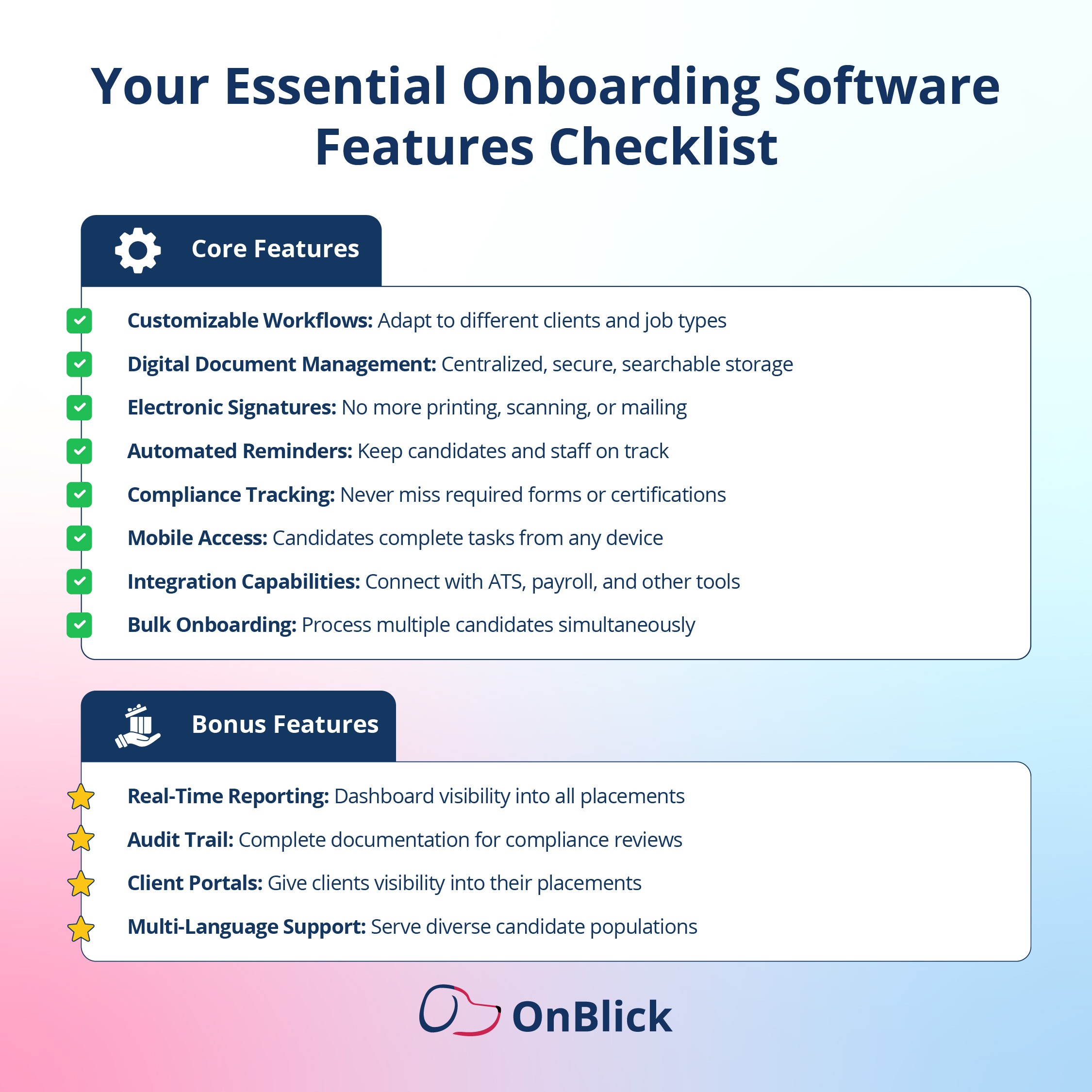
Look for customizable workflows that can adapt to different client requirements and job types. Your software should allow you to create specific onboarding paths for healthcare placements versus construction placements versus office administration roles. Each should automatically include the right forms, certifications, and compliance requirements.
Digital Document Management
Digital document management is non-negotiable. The best systems provide a central repository where all employee documents live, are easily searchable, and stay securely stored. Electronic signatures should be standard, eliminating the need for printing, scanning, and physical storage.
Automated Reminders and Notifications
Automated reminders and notifications keep everyone on track without manual follow-up from your team. The system should automatically remind candidates about pending tasks, alert HR when documents are submitted, and notify clients when their new hire is ready to start.
Compliance Management Tools
Compliance management tools built into the software ensure you never miss required forms or certifications. The system should track expiration dates, remind employees when renewals are needed, and maintain audit trails that prove your compliance during inspections.
Integration Capabilities
Integration capabilities matter more than you might think. Your onboarding software should connect seamlessly with your applicant tracking system, payroll software, and other tools you already use. This eliminates duplicate data entry and ensures information flows smoothly across your entire operation.
Mobile Accessibility
Mobile accessibility is essential in today's world. Candidates should be able to complete onboarding tasks from their phones, whether they're uploading a photo of their driver's license or signing a tax form. This flexibility dramatically improves completion rates.
How OnBlick Supports Staffing Agencies
When it comes to onboarding software specifically designed with staffing agencies in mind, OnBlick stands out as a comprehensive solution that addresses the unique challenges we've discussed. Built with immigration compliance and HR management at its core, OnBlick offers features that go beyond basic onboarding to truly support your agency's needs.
OnBlick's platform allows you to onboard multiple employees at once, a crucial capability when you're managing high placement volumes. The system handles electronic Form I-9 completion with remote verification options, making it perfect for agencies placing workers across different locations. This is especially valuable for staffing agencies working with diverse candidate pools where work authorization verification is critical.
The software manages work authorization status and history automatically, providing peace of mind that your compliance is always current. Digital signatures are built in, eliminating printing and scanning delays. The Employee Self-Service portal gives your placements direct access to their documents and information, reducing the burden on your HR team to answer routine questions.
What makes OnBlick particularly valuable for staffing agencies is its focus on compliance preparedness. The system maintains detailed audit trails that prove your processes during DOL audits or FDNS site visits. It also helps with E-Verify processing, timesheet management, and leave tracking, all integrated into one platform instead of requiring multiple separate tools.
Many staffing agencies report that OnBlick saves significant time in their daily operations. The user-friendly interface means your team can work with minimal training, and the automation features handle repetitive tasks that used to consume hours each day. This efficiency translates directly into cost savings and the ability to handle more placements without increasing headcount.
Best Practices for Implementation
Having great onboarding software is only half the battle. Successful implementation requires thoughtful planning and execution. Start by mapping your current onboarding process in detail. Identify every step, every form, and every stakeholder involved. This baseline helps you understand what needs to change and what should stay the same.
- Involve your team early in the selection and implementation process. The people who will use the software daily should have input into which system you choose and how it gets configured. Their buy-in is essential for successful adoption.
- Start with a pilot program before rolling out to your entire operation. Choose one client relationship or one type of placement to test with. This limited scope lets you work out any kinks without disrupting your entire business. Gather feedback from candidates, clients, and your internal team during the pilot.
- Training should be comprehensive but not overwhelming. Focus on the features your team will use most frequently first. Create simple guides and videos they can reference later. Schedule regular check-ins during the first month to address questions and concerns as they arise.
- Communicate clearly with candidates about the new process. Let them know what to expect, why you're using software, and how it benefits them. Most candidates appreciate the convenience and transparency of digital onboarding once they understand it.
- Monitor your metrics closely after implementation. Track completion rates, time to start, candidate satisfaction, and client feedback. Compare these numbers to your baseline to quantify the improvement. Use this data to refine your processes and prove the value of your investment.
Measuring Success
How do you know if your onboarding software is really working? Focus on these key metrics that matter most to staffing agencies.

- Time to productivity measures how quickly new hires become fully functional in their roles. Best onboarding software should reduce this significantly.
- Completion rates tell you what percentage of candidates finish the entire onboarding process. Improvements here mean fewer lost placements and happier clients. No-show rates should decrease dramatically when onboarding is smooth and engaging. Track how many placed candidates actually show up on day one.
- Client satisfaction scores reflect how well you're meeting their expectations for speed and quality. Regular feedback helps you understand if your new process is delivering the results clients care about. Your internal team's productivity is equally important. Measure how much time your HR staff spends on administrative tasks versus strategic activities.
- Cost per hire gives you a clear picture of efficiency improvements. When onboarding software reduces manual work and speeds up placement, your costs should decrease noticeably. Retention rates at the 30, 60, and 90-day marks indicate whether your onboarding process is setting people up for long-term success.
Conclusion
The staffing industry moves fast, and there's no room for outdated processes that slow down placements and frustrate everyone involved. Onboarding software for staffing agencies isn't just a nice-to-have anymore. It's become essential for competing effectively and delivering the experience both candidates and clients expect.
We've seen how the right software transforms onboarding from a painful bottleneck into a smooth, efficient process that builds confidence and satisfaction. When you can get qualified candidates started quickly, meet all compliance requirements effortlessly, and keep everyone informed throughout the process, you're not just filling positions. You're building lasting relationships and a reputation for excellence.
The investment in quality employee onboarding software pays for itself quickly through reduced administrative costs, faster placements, improved completion rates, and stronger client relationships. More importantly, it gives you the foundation to scale your agency without scaling your headaches.
As you evaluate onboarding software options, remember to look for solutions built with staffing agencies in mind. Your needs are unique, and generic HR software simply won't cut it. Choose a platform like OnBlick that understands the three-way relationships you manage, the compliance complexity you face, and the speed your clients demand. Your future success depends on having systems that work as hard as you do.
FAQs
What is employee onboarding software?
Employee onboarding software is a digital platform that automates and streamlines the process of integrating new hires into an organization. It handles tasks like document collection, form completion, compliance verification, and training assignment. For staffing agencies, the best onboarding software also manages client-specific requirements and multi-party relationships between agency, candidate, and client.
Why do staffing agencies need specialized onboarding software?
Staffing agencies face unique challenges that generic HR software can't handle. They manage three-way relationships between agency, candidate, and client. They process high volumes of placements with different compliance requirements. They need fast turnaround times that traditional processes can't deliver. Specialized onboarding software for staffing agencies addresses these specific needs with features like customizable workflows, bulk onboarding capabilities, and client-specific compliance tracking.
How long does it take to implement onboarding software?
Implementation timelines vary depending on your agency's size and complexity. Most staffing agencies can complete basic setup in two to four weeks. This includes configuring workflows, importing templates, training staff, and running pilot tests. Full adoption across all clients and placement types typically takes one to three months. The key is starting with a focused pilot program and expanding gradually based on results and feedback.
What ROI can we expect from onboarding software?
Most staffing agencies see positive ROI within three to six months. Common benefits include 50 to 70 percent reduction in administrative time, 40 to 60 percent faster time-to-start for new placements, 30 to 50 percent improvement in candidate completion rates, and significantly fewer compliance violations and associated penalties. The exact ROI depends on your current process efficiency, placement volume, and how well you implement the new system.
Is onboarding software worth the investment for small staffing agencies?
Absolutely. Small agencies often benefit even more than large ones because they have fewer resources to waste on inefficient processes. Even if you're processing 20 placements per month, the time saved, compliance protection, and improved candidate experience justify the investment.

.jpg)