.gif)



Flexible work schedules have become an important part of workforce planning for many employers. One option that often comes up is the 9/80 work schedule. It gives employees one extra weekday off every other week while still keeping the total work hours at 80 hours across a two-week period.
For employees, this schedule can offer more personal time, fewer commute days, and better control over work-life balance, while employers may see improved satisfaction and retention when it is implemented well. However, HR teams must carefully plan for coverage, time tracking, payroll, overtime rules, eligibility, and manager readiness, as the schedule can create operational and compliance issues if not properly managed.
This article explains what a 9/80 work schedule means, how it works, how it compares with other schedules, the benefits and challenges employers should consider, and what HR teams should review before adopting it.
What is a 9/80 work schedule?
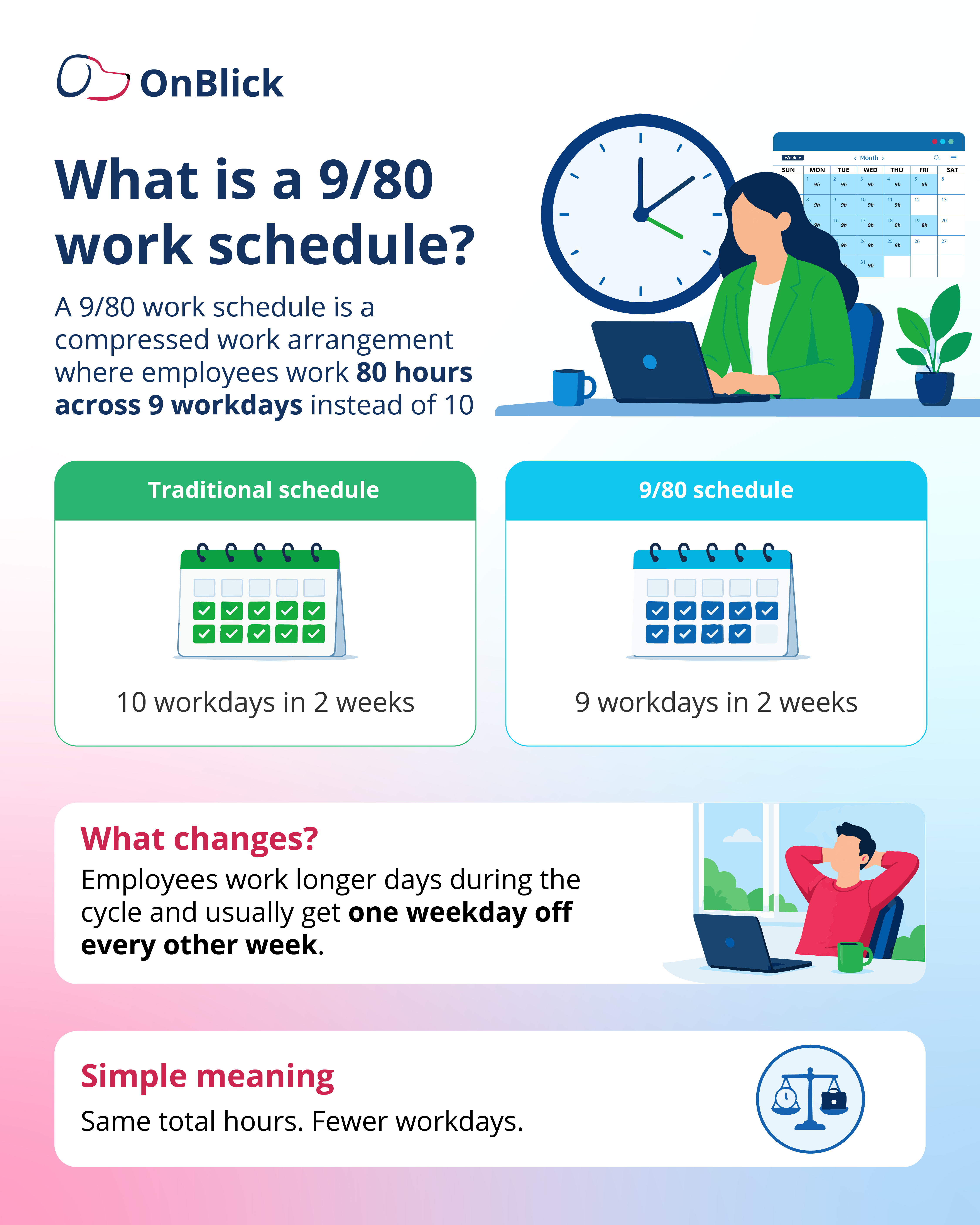
A 9/80 work schedule is a compressed work arrangement where employees work 80 hours across nine workdays instead of ten during a two-week period. In many cases, employees work longer hours on most days and receive one weekday off every other week.
- A common 9/80 schedule includes eight 9-hour days, one 8-hour day, and one day off during a two-week cycle. For example, an employee may work Monday through Friday in the first week, Monday through Thursday in the second week, and take the second Friday off.
- The main idea is simple: employees still work the same total number of hours, but those hours are spread across fewer workdays. This makes the 9/80 schedule different from reduced-hour work or part-time work.
- It is also different from a standard 5-day workweek, where employees usually work 8 hours per day, 5 days each week.
- For employers, a 9/80 schedule should be treated as a formal work arrangement. It needs clear rules for start times, end times, off days, lunch breaks, timekeeping, overtime, schedule changes, and employee eligibility.
- Without proper planning, what looks like a simple flexibility benefit can create payroll, coverage, and compliance issues.
How does a 9/80 schedule work?
- A 9/80 schedule works by spreading 80 work hours across nine days in a two-week cycle. Instead of working ten 8-hour days, employees work longer days during the cycle and receive one weekday off every other week.
A common 9/80 schedule may look like this:
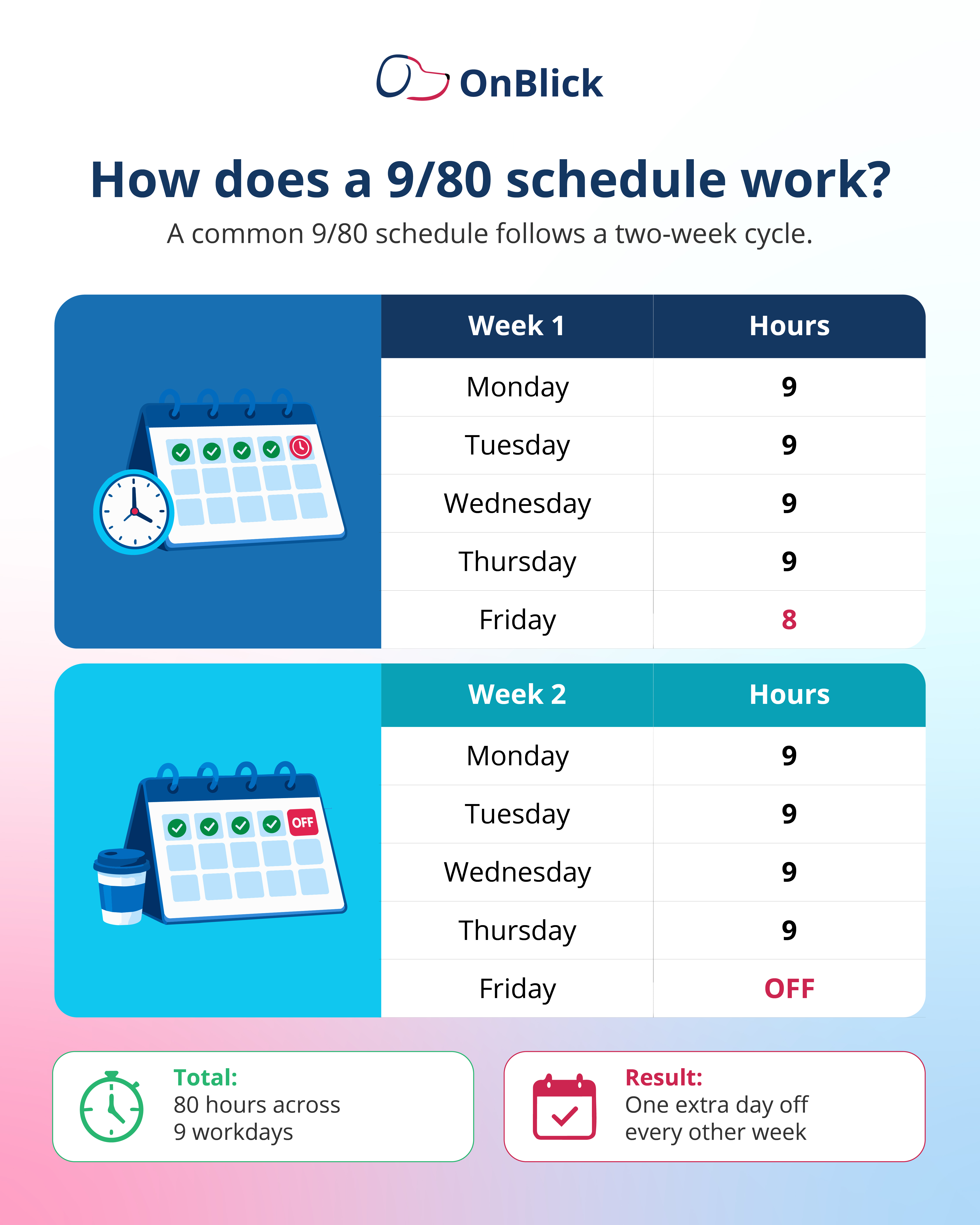
- In this example, the employee works 44 hours in the first week and 36 hours in the second week if the schedule is viewed by calendar week. Across the full two-week cycle, the total comes to 80 hours.
- Some employers use every other Friday as the off day because it is easy to understand and plan around. Others may rotate off days based on department coverage, client needs, or internal support requirements.
- HR teams should also define how breaks, lunch periods, holidays, leave, schedule changes, and exceptions will be handled. Employers should not copy a sample schedule without reviewing payroll setup, workweek definitions, employee classification, overtime rules, and applicable state requirements.
9/80 schedule vs traditional 5-day workweek
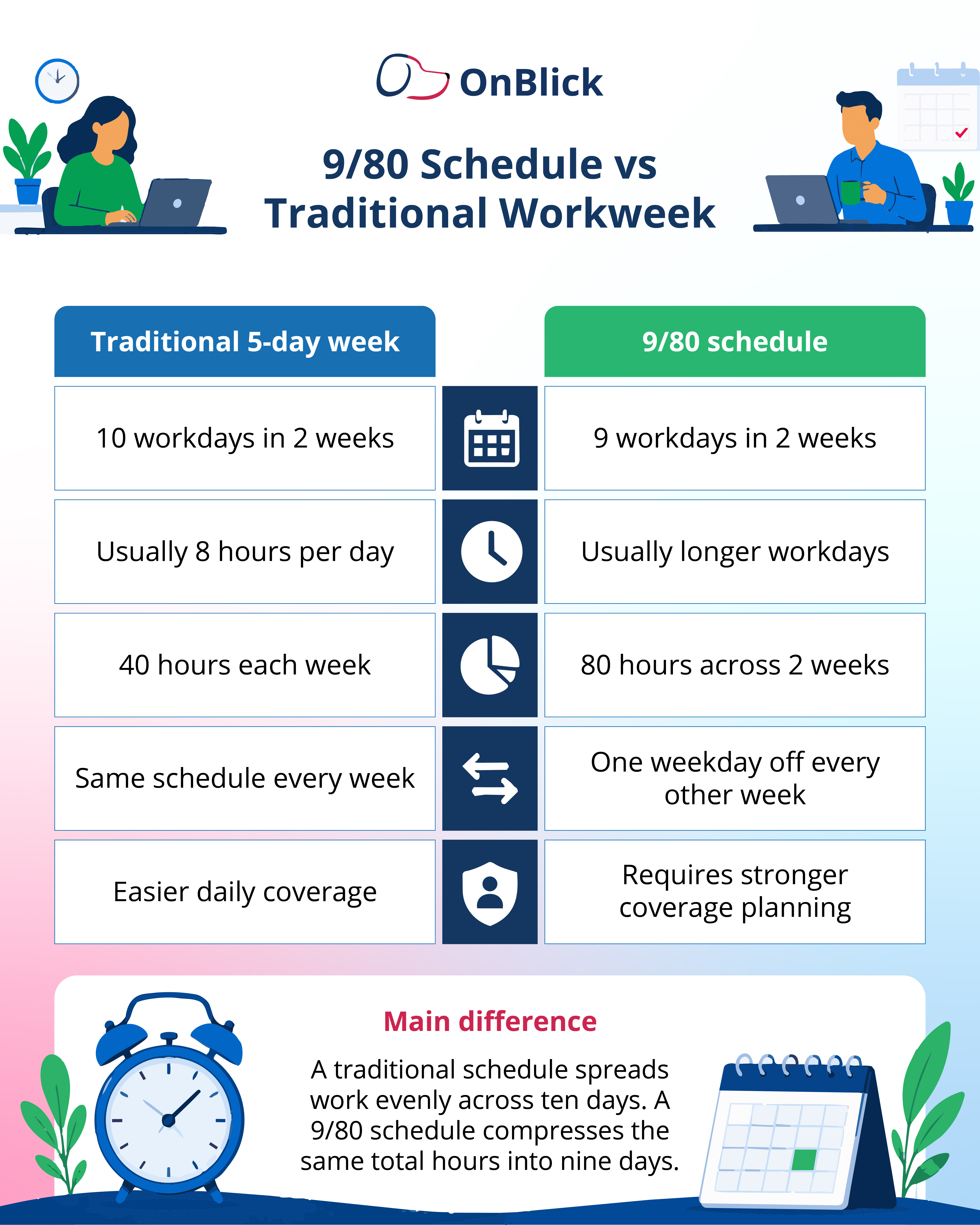
- A traditional 5-day workweek usually has employees working 8 hours per day, 5 days per week. Over two weeks, that creates 10 workdays and 80 total hours.
- A 9/80 schedule keeps the same 80-hour total, but compresses those hours into nine workdays. Employees usually work longer days during the cycle and receive one weekday off every other week.
- The traditional schedule may be easier for daily coverage, meetings, and customer support. The 9/80 schedule may give employees more flexibility and reduce commute days, but it requires better planning from HR and managers.
- For employers, the choice should depend on the type of work, employee roles, business hours, payroll setup, and coverage needs. A 9/80 schedule may be useful for some teams, but it may not fit every department or job type.
9/80 schedule vs 4/10 schedule
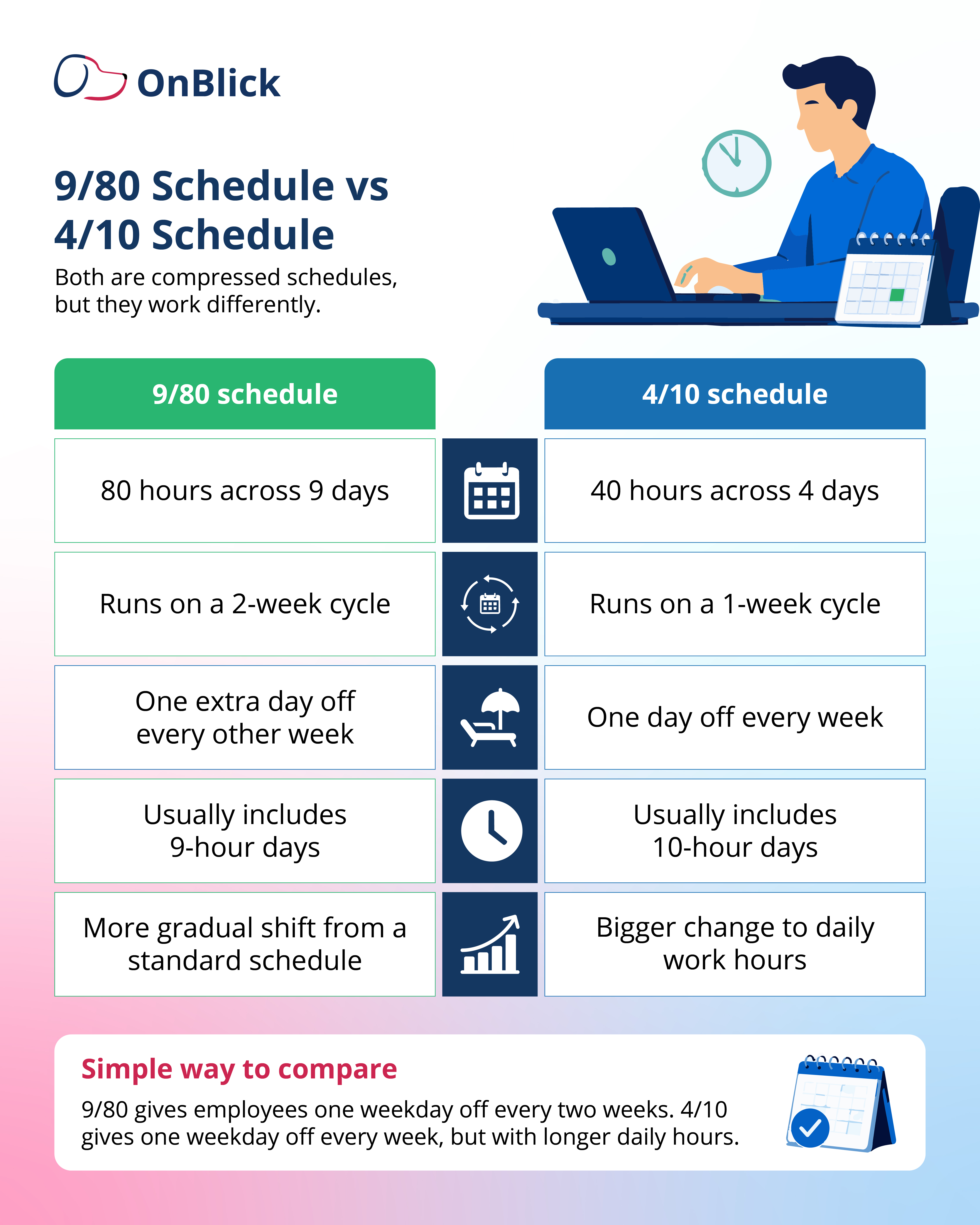
A 9/80 schedule and a 4/10 schedule are both compressed work schedules, but they are not the same. The difference is in how the hours are arranged and how often employees receive an additional day off.
- In a 9/80 schedule, employees work 80 hours across nine days in a two-week cycle. They usually work longer days and receive one weekday off every other week. This can feel closer to a standard schedule because employees are still working five days in one week and four days in the next.
- In a 4/10 schedule, employees usually work four 10-hour days each week and receive one weekday off every week. This gives employees a shorter workweek more often, but it also means each working day is longer.
- For employers, the choice depends on how much daily coverage the business needs. A 4/10 schedule may be harder for roles that need consistent customer support, daily team overlap, or frequent meetings.
- A 9/80 schedule may be easier to introduce because the change is less dramatic, but it still requires proper planning around payroll, timekeeping, workload, and off-day coverage.
Benefits of a 9/80 work schedule
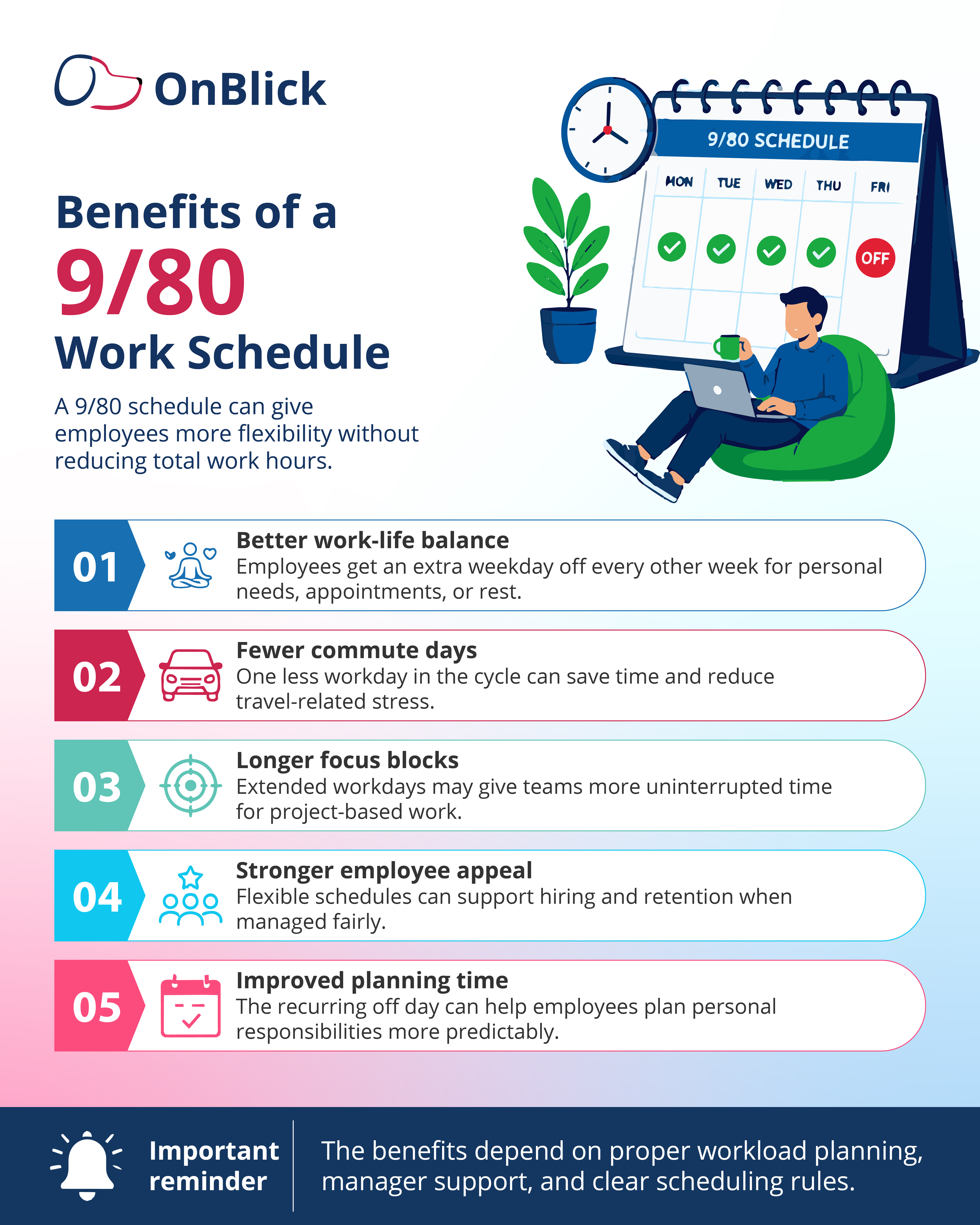
- A 9/80 work schedule can be valuable because it gives employees more flexibility without reducing total work hours. The additional weekday off every other week can help employees manage personal appointments, family responsibilities, errands, rest, or travel without using paid time off as often.
- The schedule may also help reduce commute-related stress. For employees who travel to the workplace, one fewer commute day in the cycle can save time and make the workweek feel more manageable. For hybrid teams, it can support a more predictable rhythm between office work, remote work, and personal time.
- Employers may also see benefits when the schedule is used with the right teams. Longer workdays can create larger blocks of time for focused tasks, project work, and fewer interruptions. The schedule can also support employee satisfaction, especially when employees value flexibility but the business still needs full-time coverage.
- A 9/80 schedule can also strengthen an employer’s hiring and retention efforts. Many employees compare work arrangements along with pay and benefits. Offering a structured flexible schedule can make the workplace more appealing, as long as the policy is fair, clearly explained, and supported by managers.
Challenges of a 9/80 work schedule
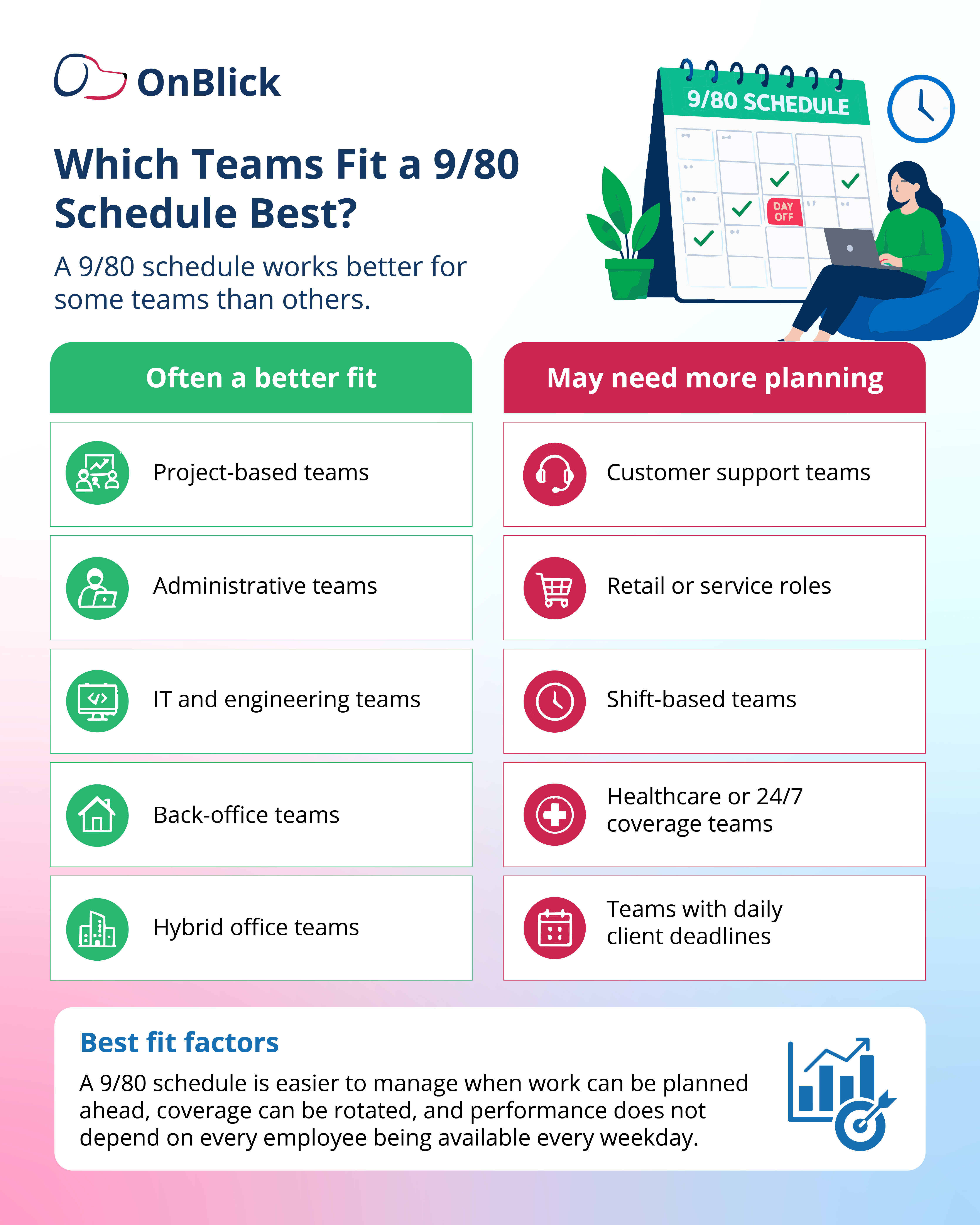
- A 9/80 schedule can create problems when it is treated as a simple calendar change. Longer workdays may not suit every employee or role. Some employees may feel tired toward the end of a 9-hour day, especially if the role involves heavy meetings, customer-facing work, physical tasks, or strict deadlines.
- Coverage can also become difficult. If several employees are off on the same Friday, the business may have fewer people available for client requests, internal approvals, urgent tasks, or team meetings. This can affect service quality unless managers plan coverage in advance.
- Workload is another concern. A 9/80 schedule should not mean squeezing the same amount of work into fewer days without adjusting priorities. If deadlines, meetings, and response expectations stay the same, employees may feel pressured to work beyond scheduled hours.
- Payroll and time tracking can also become more sensitive, especially for nonexempt employees. Employers need accurate records of hours worked, breaks, leave, holidays, and schedule changes. Without clear rules, a 9/80 schedule can lead to confusion around overtime, missed punches, off-day work, and exceptions.
- Fairness should also be reviewed. Some roles may be able to follow a 9/80 schedule easily, while others may need daily staffing. HR teams should explain eligibility clearly so employees understand why the schedule may apply to some teams and not others.
9/80 work schedule: Payroll and compliance considerations
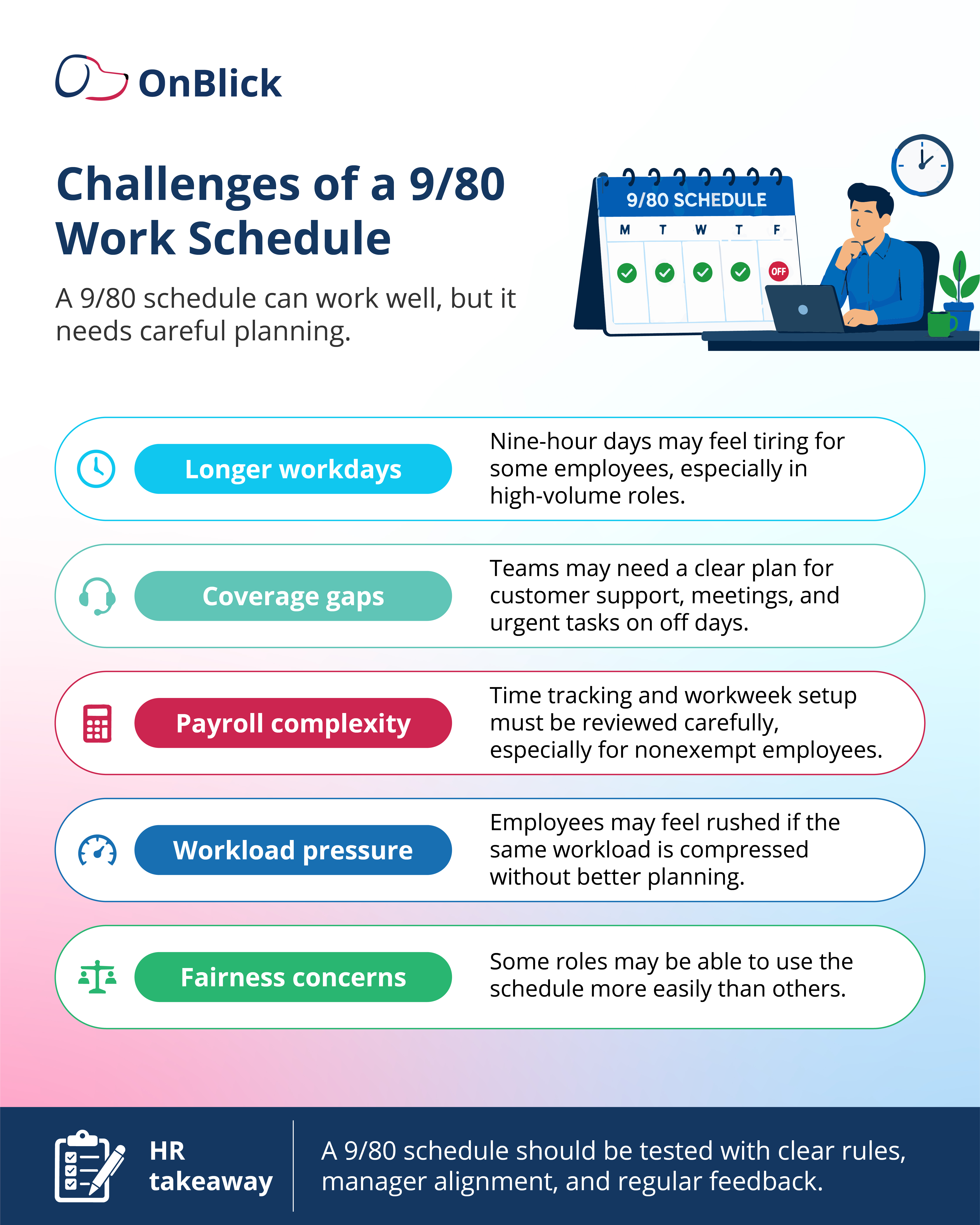
- Payroll and wage-hour review should come before a 9/80 schedule is introduced. The schedule may be easy to understand from an employee perspective, but it can create problems if the employer’s payroll system, timekeeping process, and workweek setup are not aligned.
- Under the Fair Labor Standards Act, covered nonexempt employees generally must receive overtime pay for hours worked over 40 in a workweek. The U.S. Department of Labor explains that a workweek is a fixed and regularly recurring period of 168 hours, or seven consecutive 24-hour periods.
- This matters because a 9/80 schedule is planned across two weeks, while overtime is usually reviewed by workweek. If the schedule is not set up correctly, the first week may appear to have more than 40 hours. Employers should review this carefully with payroll, HR, and legal counsel before applying the schedule to nonexempt employees.
- Employers should also check state and local rules. Some states may have daily overtime, meal break, rest break, scheduling, or wage-payment rules that affect how longer workdays are managed. A schedule that works in one state may need adjustment in another.
- HR teams should document the schedule clearly. This includes start and end times, meal periods, off days, schedule changes, holiday handling, PTO use, missed hours, and work performed on a scheduled off day. Accurate time records are especially important when employees are hourly or nonexempt.
Which teams are best suited for a 9/80 schedule?
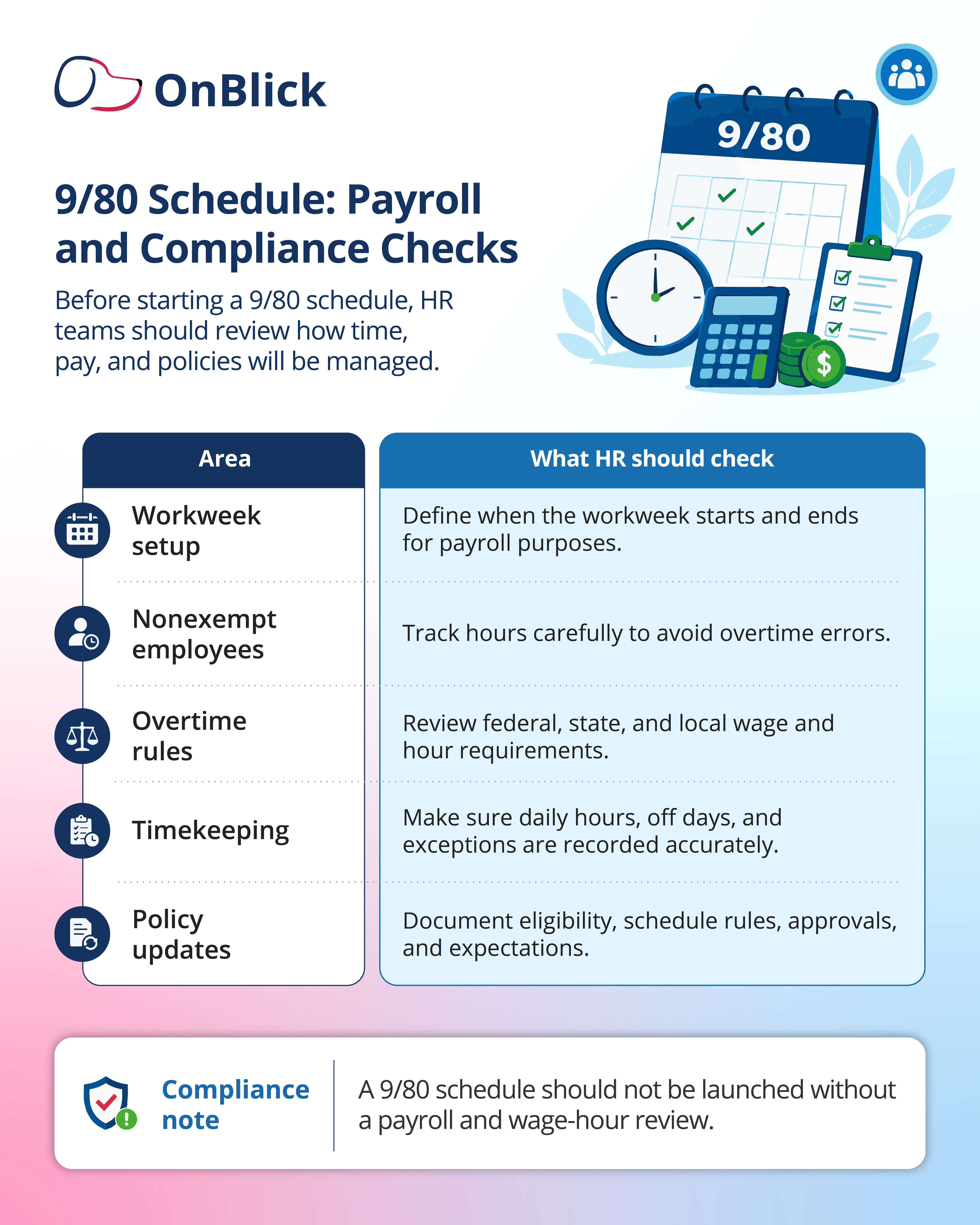
- A 9/80 schedule usually works best for teams whose work can be planned across a two-week cycle. It may fit roles where employees can manage longer workdays without affecting service quality, safety, response time, or team coordination.
- Office-based teams, administrative roles, IT teams, engineering teams, project-based departments, finance teams, and some hybrid teams may find the schedule easier to manage. These teams often have work that can be planned in advance, measured by output, or coordinated around known deadlines.
- The schedule may be harder for roles that require daily staffing or immediate response. Customer support, retail, healthcare, field services, manufacturing shifts, and 24/7 operations may need more detailed coverage planning before adopting a 9/80 arrangement.
- Employers should also consider whether the schedule will apply to all employees or only selected roles. If only some teams are eligible, HR should explain the criteria clearly. This can help avoid confusion or concerns about fairness.
- The best fit is usually a team that has predictable work, manager support, reliable time tracking, and enough staffing depth to cover the off day without overloading other employees.
How HR can implement a 9/80 work schedule
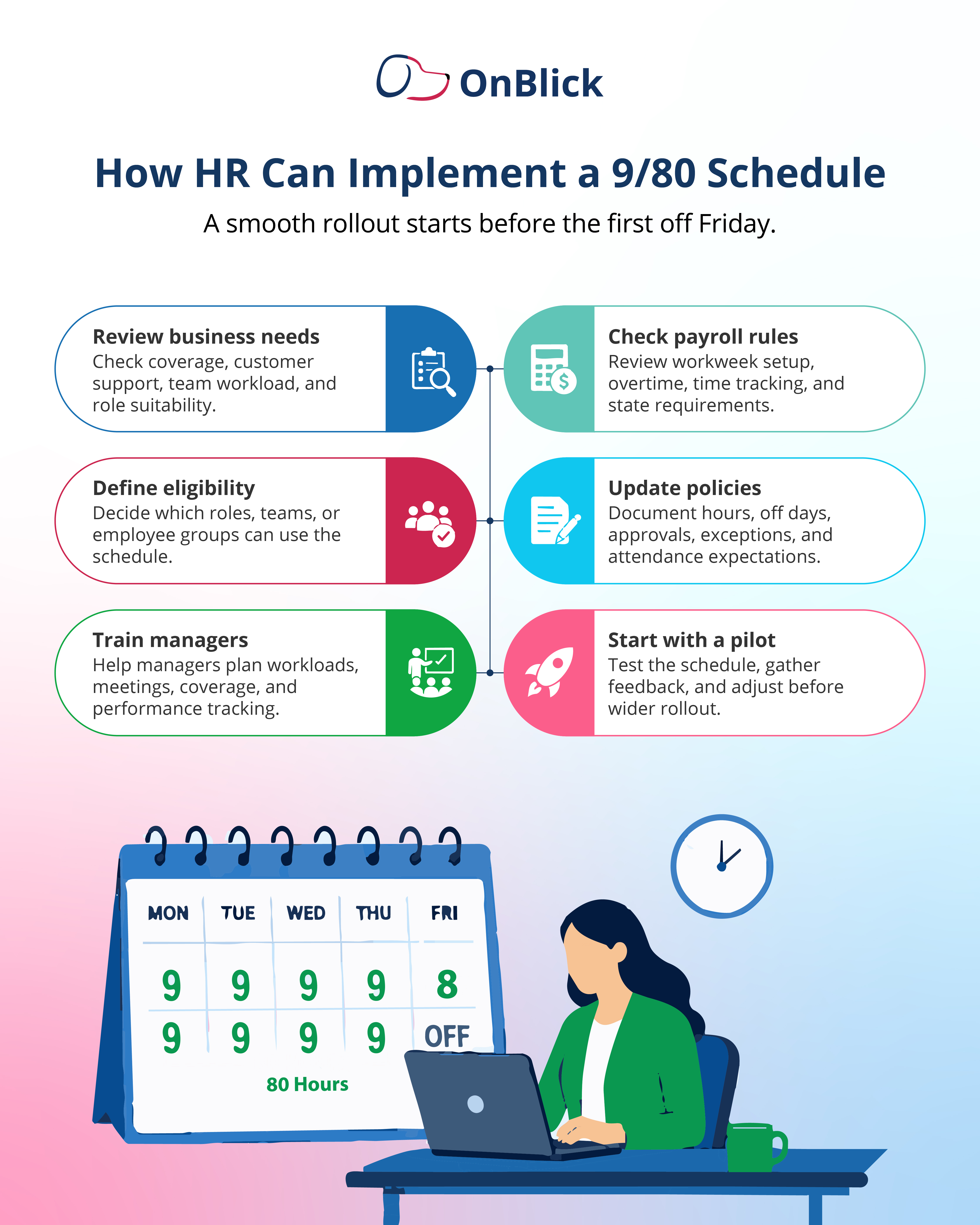
- HR should treat a 9/80 schedule as a structured policy change, not a casual flexibility option. The first step is to review whether the schedule fits the business need. This includes checking work volume, customer coverage, internal deadlines, team availability, and manager readiness.
- Next, HR should review payroll and wage-hour requirements. Workweek setup, overtime rules, employee classification, timekeeping, holidays, PTO, and state-specific rules should be checked before the schedule is announced. This is especially important when hourly or nonexempt employees are included.
- Once the legal and payroll review is complete, HR can define eligibility. The policy should explain which roles or teams can participate, how requests are approved, whether participation is optional, and how the employer may change or end the arrangement if business needs change.
- Managers also need guidance. They should know how to plan meetings, assign work, handle off-day coverage, approve exceptions, and monitor performance. Without manager alignment, the schedule can quickly become inconsistent across teams.
- A pilot can help employers test the schedule before a wider rollout. During the pilot, HR can track attendance, overtime, workload concerns, customer coverage, employee feedback, and manager experience. The results can show whether the policy needs adjustment.
9/80 Schedule: Common mistakes employers should avoid
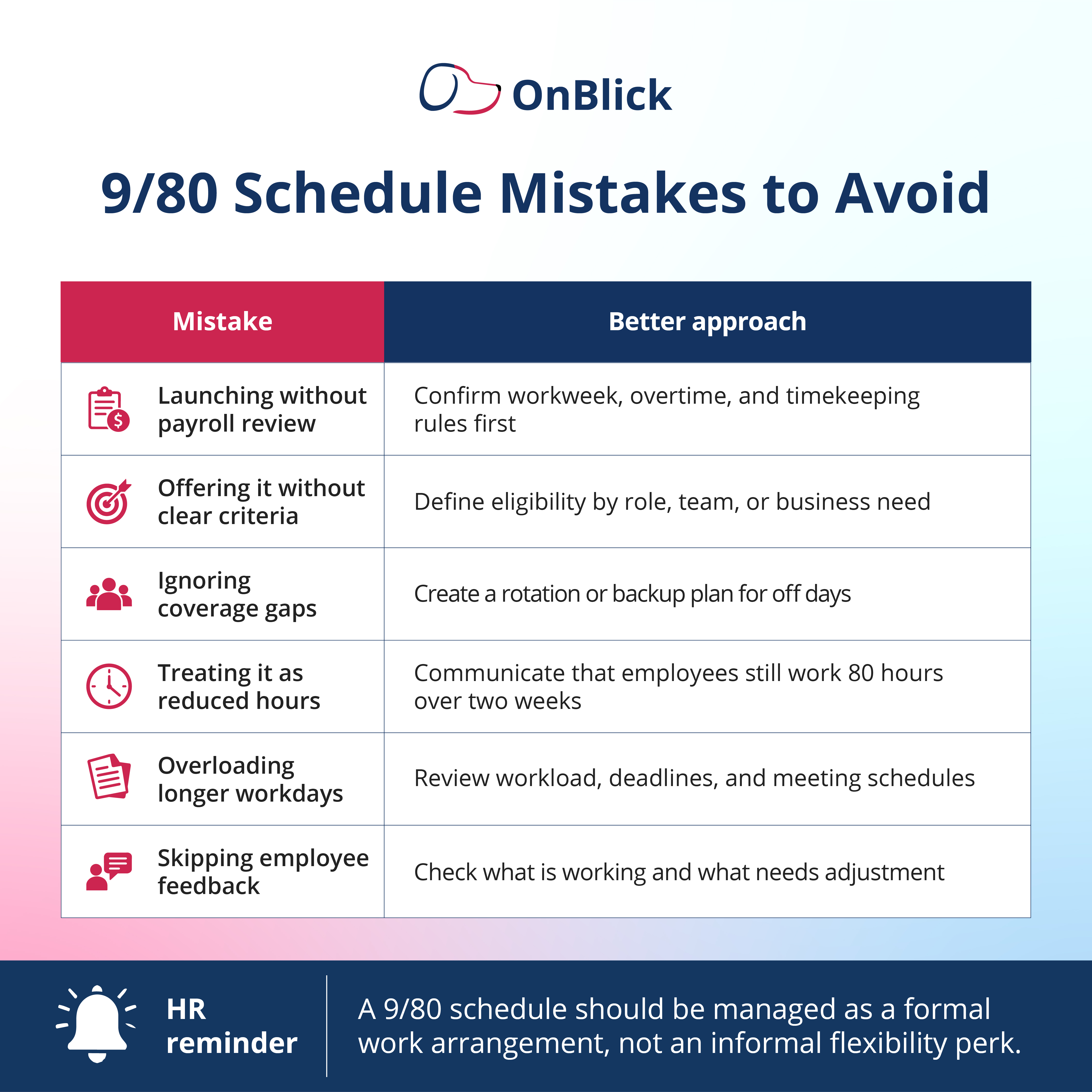
- One common mistake is launching a 9/80 schedule before reviewing payroll and overtime rules. A two-week schedule may seem balanced at 80 hours, but employers still need to understand how each workweek is treated for wage-hour purposes.
- Another mistake is offering the schedule without clear eligibility rules. If some employees can use the schedule and others cannot, HR should explain the reason based on role requirements, coverage needs, business hours, or operational limits.
- Coverage gaps can also create problems. If too many employees are off on the same day, clients, employees, or internal teams may experience delays. Employers should decide whether off days will be fixed, staggered, or rotated.
- Employers should also avoid adding longer workdays without reviewing workload. A 9/80 schedule should not lead to constant late work, skipped breaks, or pressure to respond during the off day. Managers should adjust meeting schedules and deadlines to fit the new rhythm.
- Poor communication is another issue. Employees should understand how the schedule works, what happens during holidays or PTO, how time should be recorded, and whether off-day work is allowed. Clear policy language can prevent confusion later.
How to decide if a 9/80 schedule is right for your workplace
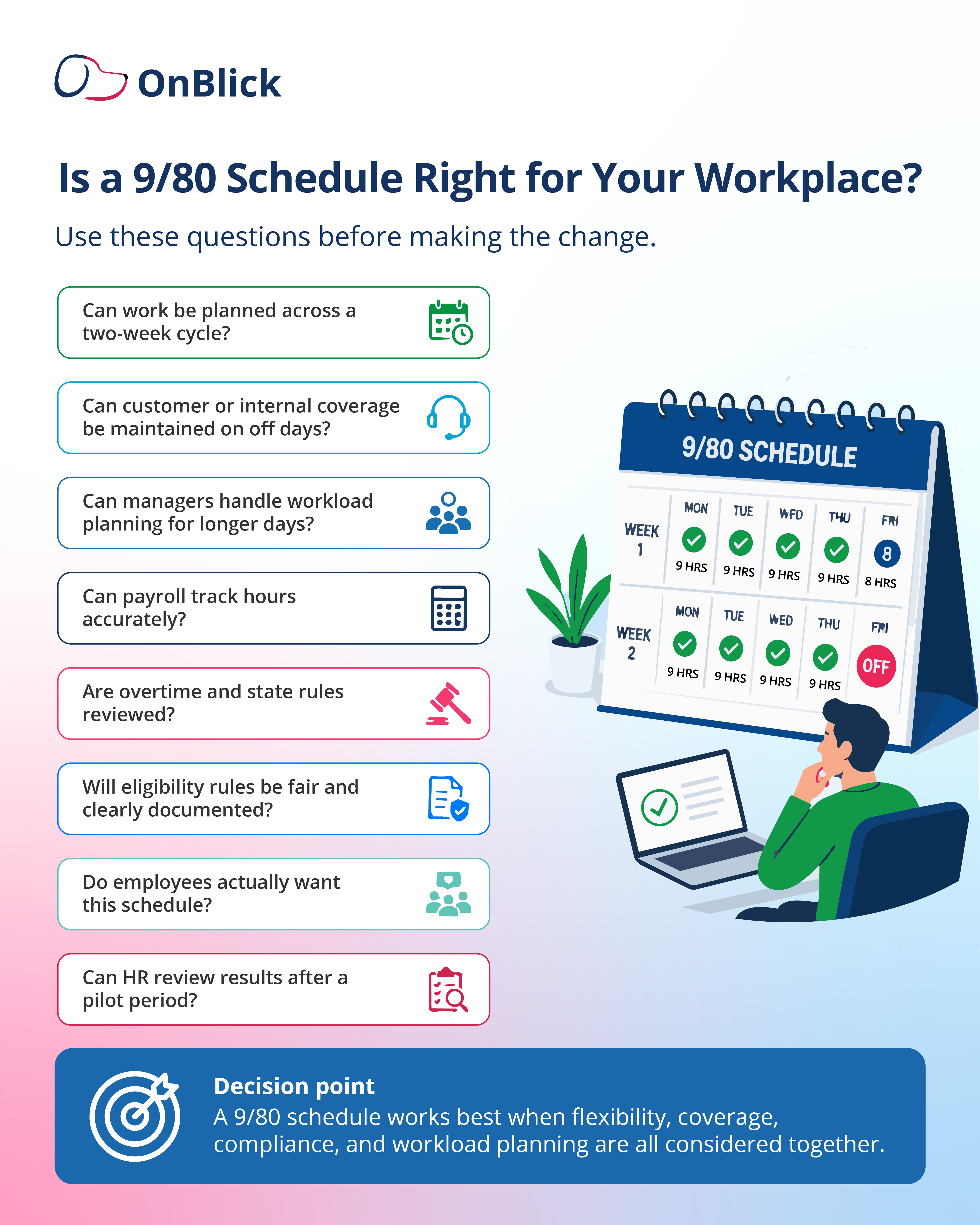
- A 9/80 schedule may be a good option when the business can maintain coverage and employees can complete their work effectively within longer days. It is not the right fit for every workplace, so HR should review both employee interest and operational needs.
- Employers can begin by asking whether work can be planned across a two-week cycle. If teams handle long-term tasks, project work, or predictable deadlines, the schedule may be easier to manage. If the work depends on daily coverage, walk-in support, or urgent response, the employer may need a more controlled approach.
- HR should also review whether managers are ready to support the change. Managers need to plan workloads, avoid unnecessary meetings, monitor burnout, and make sure off-day coverage does not fall unfairly on other employees.
- Employee feedback should also be part of the decision. Some employees may welcome the extra weekday off, while others may find longer days difficult because of caregiving duties, commute times, health needs, or personal schedules.
- The decision should come down to fit. A 9/80 schedule works best when flexibility, coverage, payroll, compliance, and employee well-being can be managed together.
How OnBlick helps HR teams manage work schedules and compliance
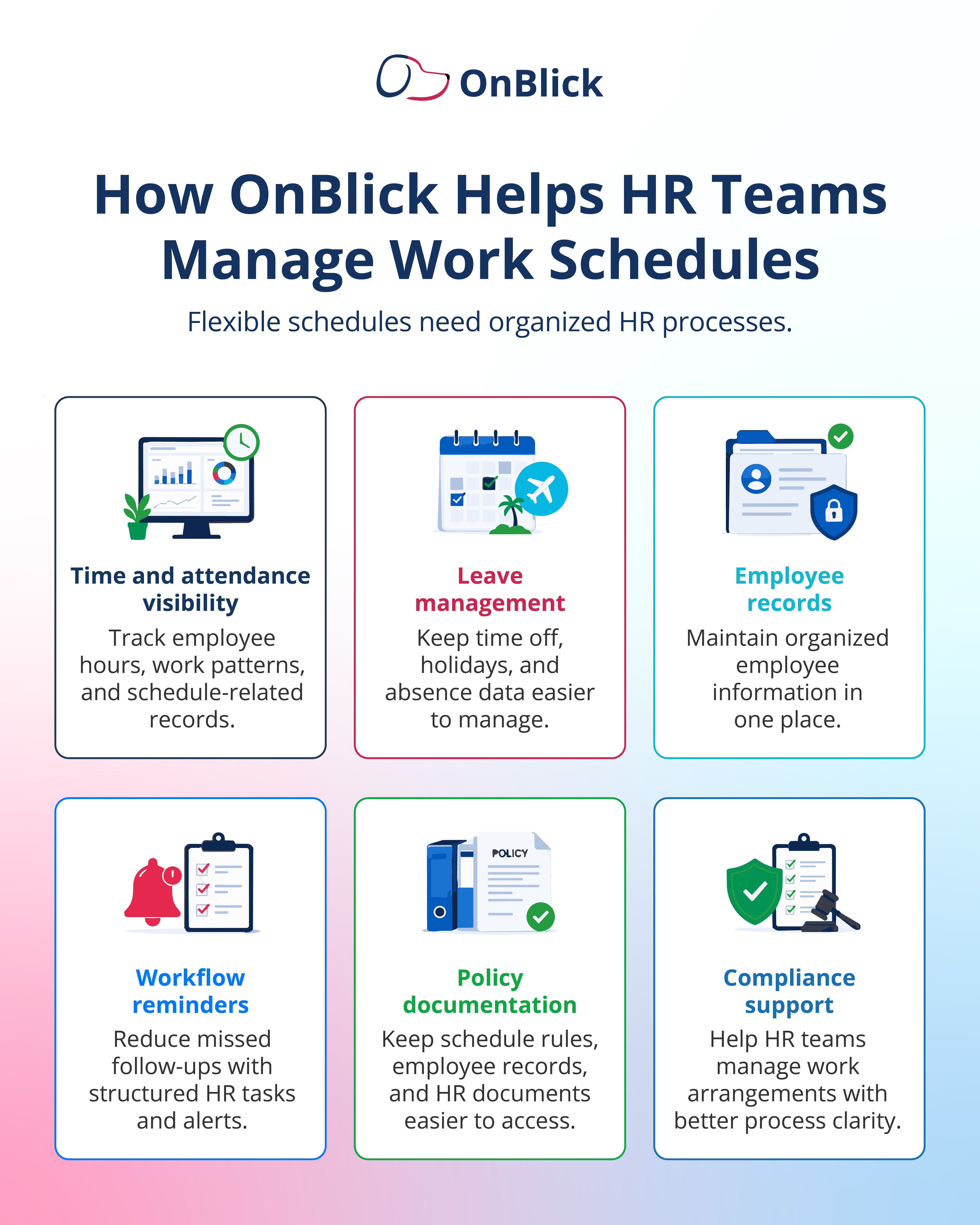
Flexible schedules need organized HR processes. When schedules change, HR teams need clear employee records, accurate time data, leave visibility, policy documentation, and workflow follow-up.
OnBlick helps HR teams manage employee information, time and attendance, leave records, onboarding workflows, documents, and compliance-related tasks from a structured platform. This can help employers maintain better visibility when employees work different schedules or follow alternative work arrangements.
For a 9/80 schedule, HR teams may need to track work hours, off days, PTO, holidays, employee classification, policy acknowledgments, and schedule-related updates. OnBlick supports these processes by helping teams reduce scattered records and manual follow-ups.
OnBlick also supports role-based access, document management, alerts, and workflow reminders. These capabilities help HR teams keep scheduling policies, employee records, and compliance tasks easier to manage.
With the right systems in place, employers can make flexible work arrangements more consistent, easier to track, and better aligned with HR and compliance needs.
Book an OnBlick demo to learn more!
FAQs about 9/80 work schedules
1. Who is eligible for a 9/80 work schedule?
Eligibility depends on the employer’s policy, job duties, coverage needs, employee classification, and applicable wage-hour rules. Many employers limit a 9/80 schedule to roles where work can be planned in advance and daily coverage can still be maintained.
2. Can hourly or nonexempt employees work a 9/80 schedule?
Hourly or nonexempt employees may be able to work a 9/80 schedule, but employers need strong timekeeping and payroll controls. Under the FLSA, covered nonexempt employees generally must receive overtime pay for hours worked over 40 in a workweek, so HR should review the setup carefully before applying this schedule.
3. Does a 9/80 schedule affect overtime?
It can. A 9/80 schedule is planned across two weeks, but overtime is usually reviewed by workweek. The U.S. Department of Labor explains that a workweek is a fixed and regularly recurring period of 168 hours, or seven consecutive 24-hour periods. Employers should review the workweek setup, employee classification, and state rules before rollout.
4. How should employers set the workweek for a 9/80 schedule?
Employers should define the workweek before starting the schedule and make sure payroll, timekeeping, and policy documents follow the same setup. This is especially important for nonexempt employees because the workweek is used to determine overtime obligations.
5. Can a 9/80 schedule work for remote or hybrid teams?
Yes, a 9/80 schedule can work for remote or hybrid teams if expectations are clear. Employers should define core working hours, meeting rules, response expectations, off-day coverage, time tracking, and how schedule changes will be handled.
6. What happens if an employee works on their scheduled off day?
Work performed on a scheduled off day should be recorded and handled according to the employer’s policy and wage-hour rules. For nonexempt employees, all hours worked should be tracked. HR should also clarify whether off-day work requires prior approval.
7. What are the main benefits of a 9/80 work schedule for employees?
Employees may value the extra weekday off every other week for personal appointments, rest, family responsibilities, or errands. The schedule may also reduce commute days and give employees more control over their time without reducing full-time hours.
8. What are the main disadvantages of a 9/80 work schedule?
The main disadvantages include longer workdays, possible fatigue, coverage gaps, payroll complexity, off-day interruptions, and fairness concerns if only some roles can use the schedule. These issues can be reduced with clear rules and manager planning.
9. How can employers avoid coverage gaps in a 9/80 schedule?
Employers can avoid coverage gaps by staggering off days, rotating schedules, setting backup coverage, limiting how many employees are off on the same day, and planning meetings around team availability. Customer-facing and support teams may need stricter coverage rules.
10. How should HR teams prepare before starting a 9/80 schedule?
HR teams should review business needs, employee classifications, overtime rules, state requirements, payroll setup, timekeeping, leave handling, holidays, policy language, and manager training. A pilot period can help test the schedule before making it permanent.
Conclusion
A 9/80 work schedule can be a useful option for employers that want to offer more flexibility while keeping full-time hours in place. It gives employees an extra weekday off every other week and can support work-life balance, employee satisfaction, and retention.
At the same time, the schedule needs careful planning. HR teams should review payroll setup, overtime rules, employee classification, coverage needs, manager readiness, and state-specific requirements before introducing it.
The best results usually come from a clear policy, accurate time tracking, manager training, employee communication, and regular review. When the schedule is planned well, a 9/80 arrangement can give employees more flexibility without creating unnecessary confusion for HR or the business.