.gif)

.png)

The seemingly simple Form I-9, issued by U.S. Citizenship and Immigration Services (USCIS), remains a critical part of the employee onboarding process. It helps employers verify the identity and employment authorization of every new hire in the United States, while supporting compliance with federal employment eligibility verification rules.
Employers should now ensure they are using the current Form I-9 and following the latest USCIS instructions, including updated language, acceptable document guidance, Supplement A and Supplement B requirements, and remote document examination rules for qualified E-Verify employers.
This blog will help you complete Form I-9 more accurately, avoid common errors, and reduce compliance risks during onboarding, internal audits, or government inspections.
The Cost of Confusion
- Errors on Form I-9 are not just clerical mistakes. Inaccurate, incomplete, late, or poorly maintained I-9 records can lead to financial penalties, legal exposure, and increased scrutiny during an ICE inspection.
- As of the 2025 DHS penalty adjustments, I-9 paperwork violations can result in fines ranging from $288 to $2,861 per relevant individual. Employers may also face higher penalties if they knowingly hire or continue to employ unauthorized workers.
- Beyond fines, I-9 errors can create reputational concerns, disrupt HR operations, and make audit responses more difficult. That is why employers should treat Form I-9 accuracy as a core part of their onboarding and compliance process.
Understanding the New Form I-9
The current Form I-9 is designed to make employment eligibility verification clearer and more organized. Employers should be familiar with the current form structure and instructions before completing or correcting employee records.
Notable changes include:
- The current Form I-9 includes updated wording and instructions that employers should review carefully.
- Section 1 must be completed by the employee no later than the first day of employment, but not before the employee has accepted the job offer.
- Section 2 must be completed by the employer or authorized representative within three business days after the employee’s first day of employment.
- Supplement A is used when a preparer or translator assists the employee with Section 1.
- Supplement B is used for reverification and rehire, when applicable.
- Employers enrolled in E-Verify and in good standing may be eligible to use the DHS-authorized alternative procedure for remote document examination.
Employers should review the USCIS Form I-9 instructions regularly to make sure their HR teams follow the latest requirements.

How to Avoid the New Form I-9 Mistakes
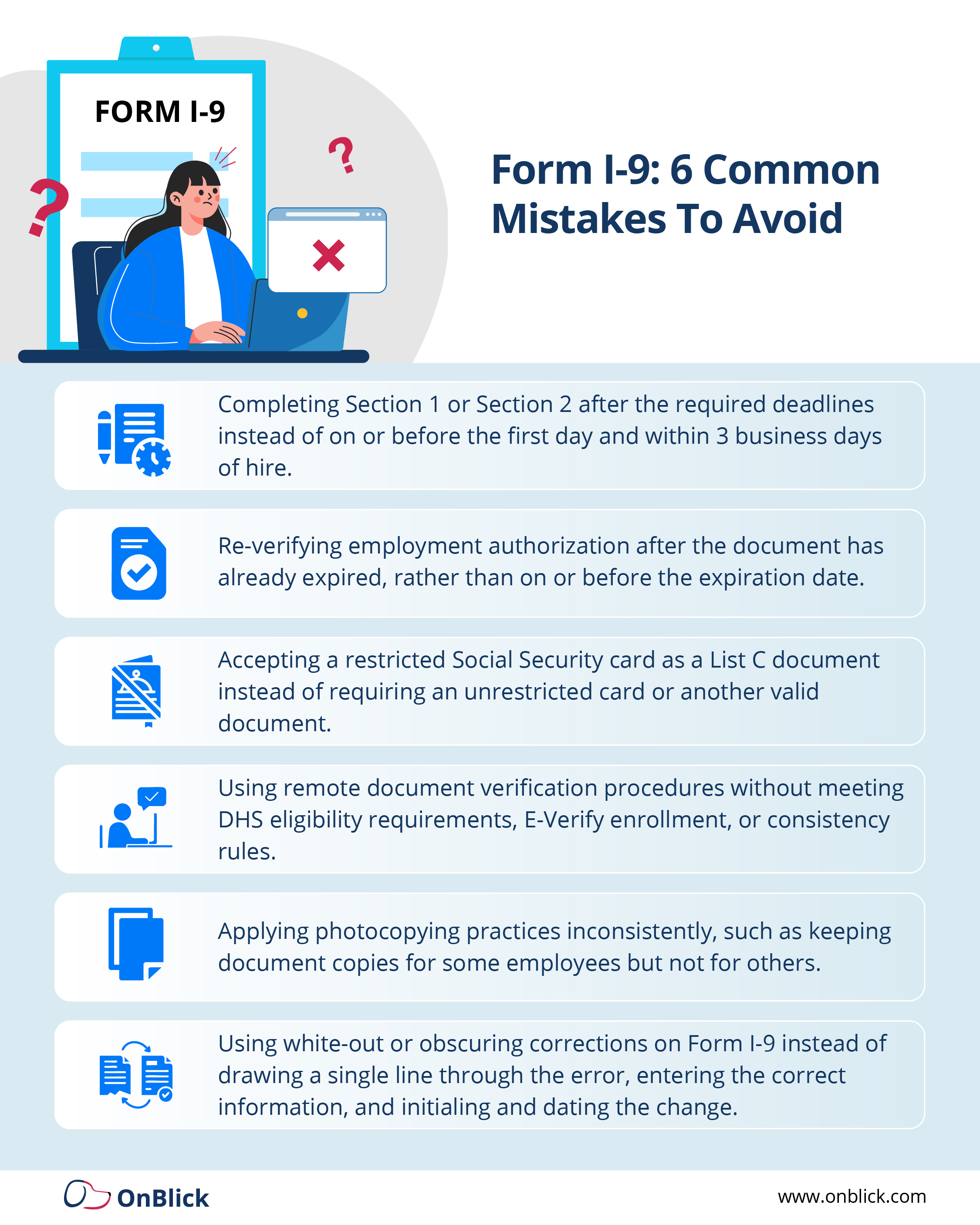
Here’s how you can master the new I-9 in 7 simple steps:
- Review Acceptable Documents Carefully: Employees may present one document from List A or a combination of one document from List B and one document from List C. Employers should review the Lists of Acceptable Documents and record the document information accurately in Section 2. Avoid requesting specific documents from employees. The employee has the right to choose which valid documents to present from the acceptable document lists. Asking for more or different documents than required may create discrimination-related compliance risks.
- Follow the Current USCIS Instructions: Form I-9 instructions should guide every step of the completion process. Employers should make sure employees complete Section 1 on time and that HR teams or authorized representatives complete Section 2 within the required timeframe. Skipping instructions, using outdated assumptions, or relying on old completion practices can lead to avoidable errors. Employers should also train HR teams on anti-discrimination requirements, proper document review, and correction procedures.
- Use Supplement A Correctly: Supplement A is used when a preparer or translator helps an employee complete Section 1. If more than one preparer or translator assists the employee, each must complete the required certification. Employers should ensure Supplement A is attached to the employee’s completed Form I-9 and retained with the I-9 record. This helps maintain a complete audit trail if the form is reviewed later.
- Check Signatures, Dates, and Required Fields: Before storing Form I-9, review the form for missing signatures, incorrect dates, incomplete fields, or mismatched information. The employee must sign and date Section 1, and the employer or authorized representative must sign and date Section 2. If Form I-9 is created, signed, stored, or retained electronically, employers should ensure their electronic system meets applicable requirements for electronic signatures, access controls, audit trails, and record retention.
- Retain Form I-9 Records Properly: Employers must retain Form I-9 for each employee for three years after the date of hire or one year after employment ends, whichever is later. Forms should be stored securely and be easy to retrieve if requested during an inspection. Employers do not submit Form I-9 to USCIS during normal onboarding. Instead, they must keep it available for inspection by authorized government agencies, such as DHS, ICE, DOL, or DOJ.
- Manage Supplement B for Reverification and Rehire: Supplement B is used when an employer needs to reverify employment authorization or record a qualifying rehire. Employers should track work authorization expiration dates and set reminders well before reverification is due. Clear procedures are important because missed reverification deadlines can create compliance risks. HR teams should also understand when reverification is not required, such as for U.S. citizens and lawful permanent residents who present a Permanent Resident Card during initial verification.
- Stay Updated and Seek Expert Guidance: Form I-9 requirements can change, so employers should monitor USCIS, ICE, and E-Verify updates regularly. This is especially important for remote or distributed hiring. Qualified E-Verify employers may use the DHS-authorized alternative procedure for remote document examination if they meet the required conditions. Employers that are not eligible must continue with physical document examination or use an authorized representative to review documents on their behalf.
Employers should also be prepared for inspections. If ICE serves a Notice of Inspection, employers are generally given at least three business days to produce requested Forms I-9 and supporting records.
Summing Up
Completing Form I-9 accurately is essential for every employer. By using the current form, following USCIS instructions, reviewing documents properly, retaining records correctly, and keeping track of reverification deadlines, HR teams can reduce errors and improve audit readiness.
A consistent Form I-9 process also helps employers avoid rushed corrections, missing documents, and compliance gaps during onboarding or government inspections.
How Does OnBlick Help?
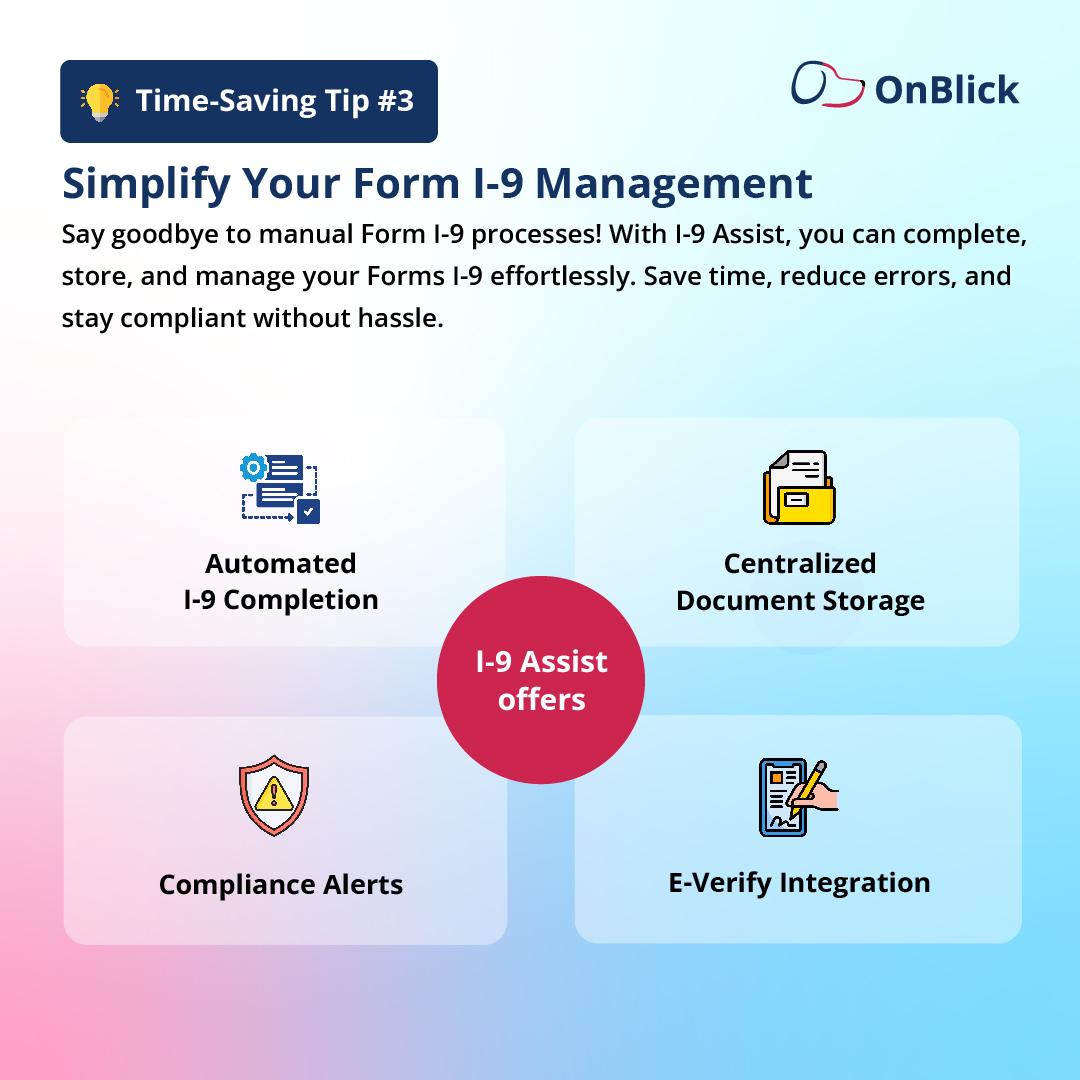
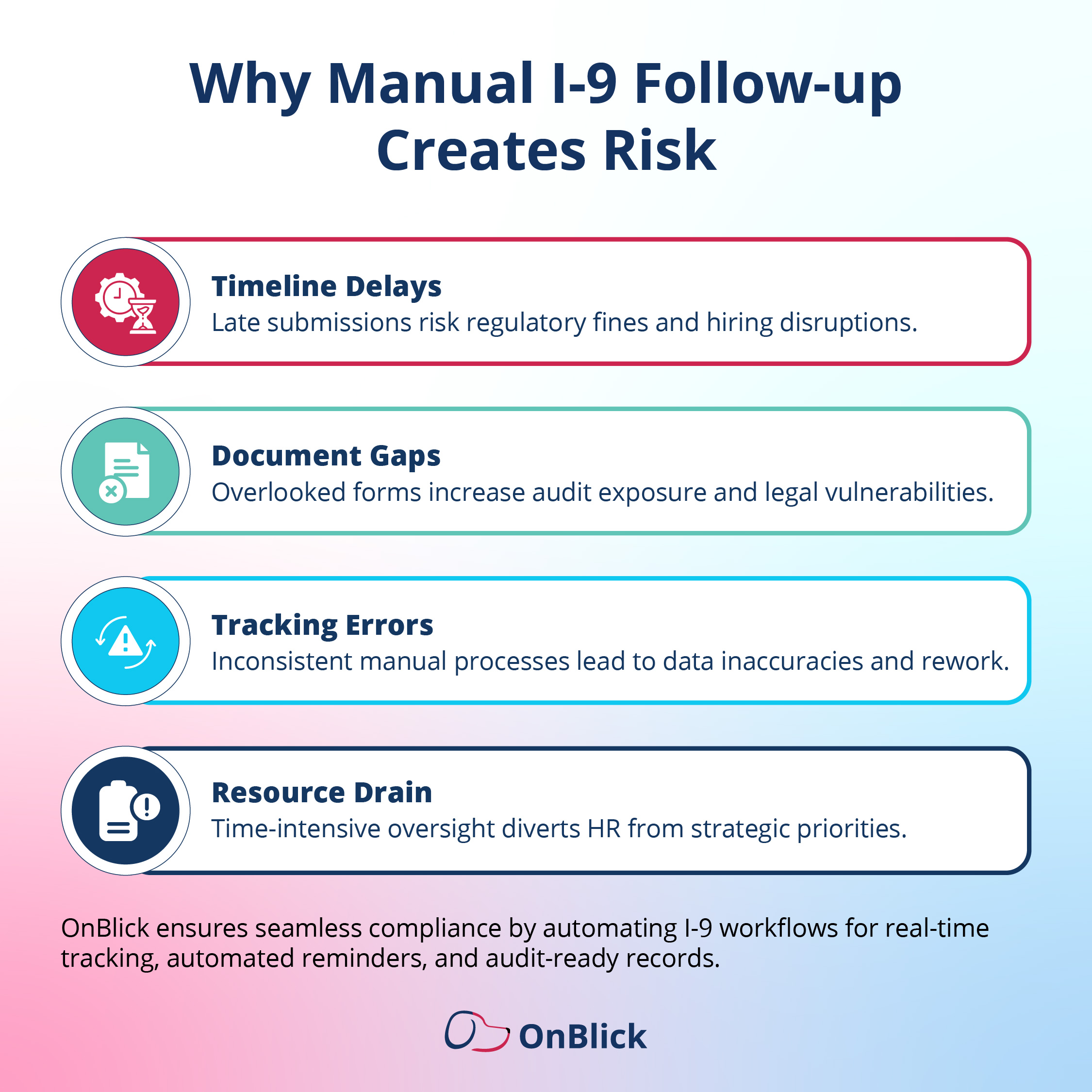
OnBlick’s I-9 Assist helps employers manage Form I-9 compliance with digital workflows, electronic signatures, automated reverification reminders, secure record retention, and detailed audit trails. The platform helps HR teams reduce manual errors, track completion status, and maintain organized I-9 records across the employee lifecycle.
For remote and distributed hiring, OnBlick also supports Live Video Verification and Authorized Representative Network workflows to help employers complete I-9 verification with greater visibility and control.
Schedule a free OnBlick demo to see how I-9 Assist can help your team simplify Form I-9 compliance and stay audit-ready.